Best CRM for Shopify Developers in 2026
Best CRM for Shopify and e-commerce developers: six client-work tools compared on price, retainer billing, change control and portals, plus a trial test.
We make Workspace369 and list it first here. Weigh our ranking with that in mind, and if another tool fits you better, use it.

By Simon Dziak, Founder, Workspace369 · LinkedIn
The best CRM for Shopify / e-commerce developers keeps the build proposal, the support retainer, the invoices and every out-of-scope request on one merchant record, and leaves code, themes and the store itself to Shopify and your repository. For small shops that sell builds plus monthly support, our pick is Workspace369; Bonsai and Moxie cost less for one or two people, and Productive suits larger teams. For the wider decision, start with the best agency management software guide. To price a support retainer first, use the free retainer pricing calculator.
Disclosure and method: Workspace369 publishes this guide and is one of the options. It is a documentation-based shortlist, not a hands-on benchmark. Official vendor pages were reviewed on October 19, 2026. Check current plans with each vendor before you buy.
Key takeaways
- A CRM for Shopify developers should hold the build proposal, the support retainer, the invoices and every out-of-scope request (a new checkout customization, an extra app integration) on one merchant record; it does not run your code, theme or store.
- Workspace369 Cadet at $29 a month ($23.25 billed yearly) lists proposals, contracts, retainers, recurring invoices, intake forms, time tracking and a client portal for one seat and 5 active projects; change orders, proposal revisions and webhooks and API start at Specialist ($149 a month, 10 seats). Its plan matrix names no Shopify integration.
- Bonsai Essentials is cheaper than Cadet even for one person ($19 per user a month billed yearly, $25 monthly) and lists proposals, contracts, a client portal and retainer invoices; Moxie Pro ($20 a month billed yearly, $25 monthly) adds a white-labeled portal, request management and webhooks and a public API.
- Productive lists retainer management and retainer invoicing with budgets and resource planning for agencies of three or more (three-seat minimum); Teamwork.com lists time budgets, retainers and invoices from logged time on Accelerate ($24.99 per user a month billed yearly).
- Test each tool by taking one fictional merchant through a theme build, a mid-build checkout request and a support-retainer month, and check that the change, the approval and the invoice stay on one record.
What's inside?
What a CRM for Shopify developers is (and what it is not)How we compared these toolsThe best CRM for Shopify developers in 2026Side-by-side comparisonWhich tool fits your Shopify practice?Run a mid-build checkout-change test during the trialKeep code and store data where they belongWhen to keep it simple
What a CRM for Shopify developers is (and what it is not)
A CRM for a Shopify or e-commerce developer is the business side of the merchant relationship: who the client is, what you quoted for the build, which theme or app work was agreed, what monthly support you sell, what extra requests arrived mid-project and what is still unpaid. It is not a code editor, a deployment pipeline or an order and inventory system. A storefront redesign that gains a custom checkout requirement is a scope question first, and the record should show who approved it and at what price. Workspace369's plan matrix does not name a Shopify integration, so treat it as the place for the agreement and invoice, not a store sync.
How we compared these tools
We compared each tool on the same five points, using only the vendor's own pricing pages as read on October 19, 2026:
- Entry price and the price of the plan that lists retainer billing, monthly and billed yearly, per user where the vendor prices that way.
- Retainer and invoice coverage: retainers or recurring invoices, and invoices built from logged time.
- Scope control and onboarding: proposals, contracts, forms for store access details, a client portal, and a way to record extra work.
- Seat limits and minimums that change the price for a team of one to five.
- Trial terms: length, and whether the vendor says a card is needed.
We did not test speed, support, reliability or mobile apps, did not test any Shopify connection, and did not use third-party ratings. Order reflects documented fit for a freelancer or small agency selling builds and support retainers. Workspace369 is first because its plan matrix names deposit on acceptance, optional add-on line items and proposal engagement tracking on Cadet, and Bonsai's pricing page names none of them (its contracts page describes deposit capture, with no plan gate shown). If you do not need those, Bonsai Essentials lists the same core chain for less and may be the better choice.
The best CRM for Shopify developers in 2026
1. Workspace369, best for small shops selling builds plus a support retainer
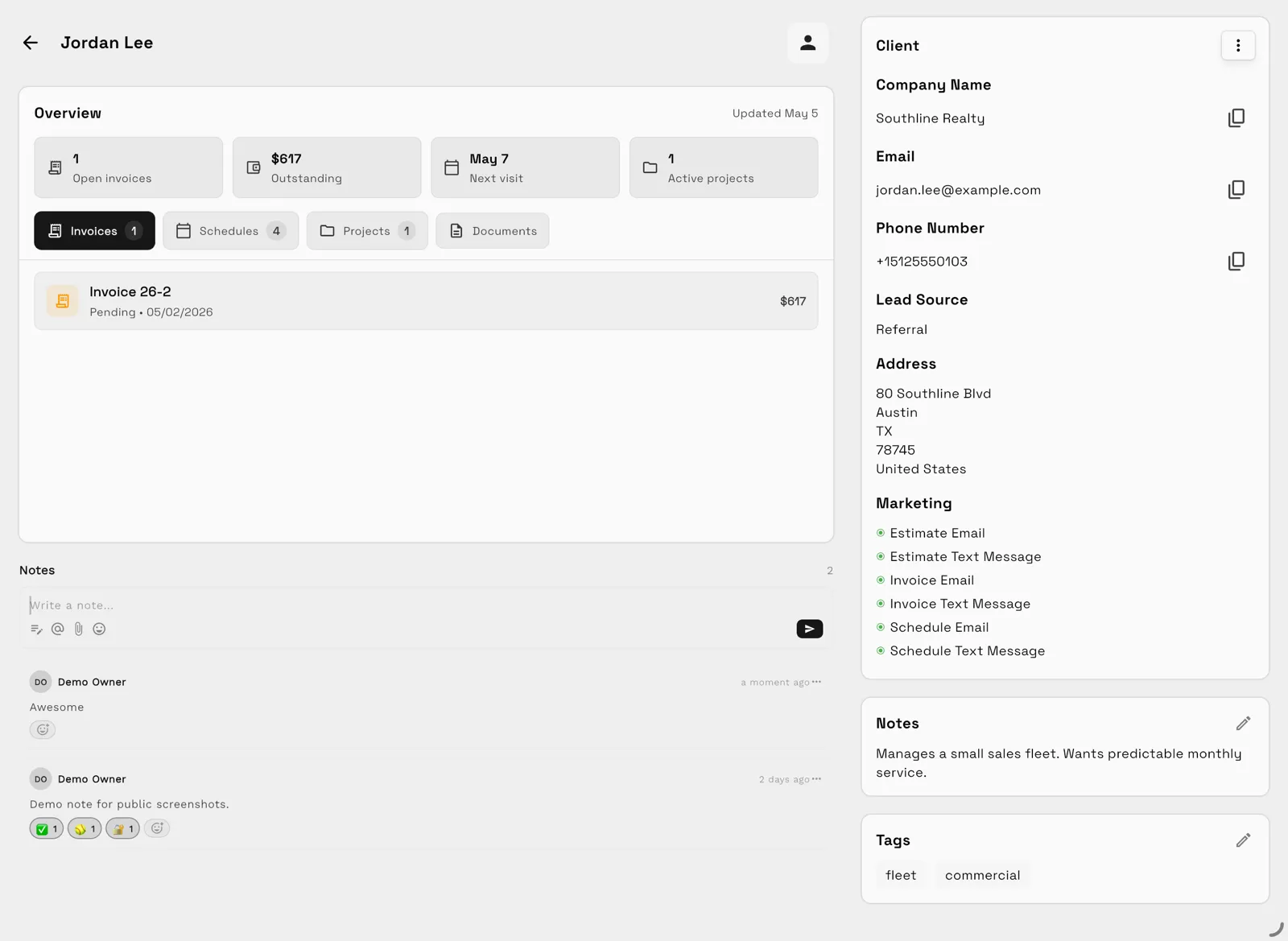
Workspace369 keeps the merchant record, a proposal with contracts and optional add-on line items, a retainer, tasks, time tracking, a client portal and invoices in one place. Cadet is $29 a month for one seat ($23.25 billed yearly) and lists proposals, contracts with e-signature, optional line items, retainers and payment schedules, recurring invoices, public intake forms, a client portal and time tracking on the plan. Public forms can collect onboarding details such as the store URL and who will grant access. Voyager ($74 a month, $59.25 billed yearly) adds a second seat, unlimited projects, a timeline or Gantt view and a project financials dashboard. The screenshot is a demo record, not a customer result.
Limitations: Cadet has one seat and 5 active projects, with $10 a month per extra seat from Voyager. Change orders, which record scope creep beside the signed proposal, proposal revisions, expense tracking and webhooks and API start at Specialist ($149 a month, 10 seats); on Cadet and Voyager, send a new proposal for the extra work. The plan matrix names no Shopify integration, so any store connection means building it on the API. Bonsai Essentials lists proposals, contracts, a portal and retainer invoices at $19 per user billed yearly, below Cadet for one person. The 14-day trial needs a card.
Best for: freelancers on Cadet, or teams of up to ten on Specialist ($149 a month), who want the agreement, the approval and the invoice together and sell both builds and recurring support.
2. Bonsai, best for the lowest price per seat with proposals and a portal
Bonsai lists Essentials at $19 per user a month billed yearly ($25 monthly). Essentials lists invoices and payments, proposals and contracts, forms and questionnaires, scheduling, a client portal and expense tracking, and the comparison table lists retainer invoices and subscription invoices among its billing rows. Basic is $9 billed yearly ($15 monthly) with time tracking and a CRM but no invoices. Premium ($29 billed yearly, $39 monthly) adds a deals pipeline, Gantt view, workload management, custom fields and client tasks and messaging. The trial runs 7 days, and the page says you will be asked for card details to continue.
Limitations: pricing is per user, so three people on Essentials cost $57 a month billed yearly or $75 monthly; Elite has a three-user minimum. Scope-change handling beyond a new proposal is not named on the pricing page, and webhooks or a public API are not named either (Zapier is listed on Premium).
Best for: one to three person shops that want proposals, a portal and retainer invoices at the lowest per-seat price and can bill extra work through a new proposal.
3. Moxie, best for a portal, requests and webhooks at a flat team price
Moxie Starter is $12 a month ($10 billed yearly) and lists client and project management, invoicing and payments, proposals, quotes and contracts, time tracking, a sales pipeline and a custom form builder. Pro is $25 monthly ($20 billed yearly) and adds a white-labeled client portal, support ticketing and client request management, workflow automations and API integrations (Zapier, Make, webhooks and a public API). Teams is $40 monthly ($32 billed yearly) and covers up to five team members. The page title mentions a 14-day free trial; card terms are not stated there.
Limitations: retainers and recurring invoices are not named on the pricing page, so check how a monthly support fee repeats before you commit. The portal, request management and API access start at Pro, not Starter. Five team members is the stated ceiling on Teams.
Best for: one to five person shops that want request management and API access at a low flat price and can bill support manually each month.
4. Productive, best for agencies that need budgets and resourcing
Productive is an agency operations tool built around budgets, time and resource planning. Its pricing page lists Essential at $10 per user a month billed yearly ($12 monthly) and Professional at $25 ($29 monthly), and the FAQ says all plans require at least three seats. Professional lists recurring budgets, and the feature rows list retainer management and retainer invoicing, alongside invoices and client access to budgets. The sign-up block gives a 14-day free trial with no card required. For three people on Professional that is $75 a month billed yearly, or $87 monthly.
Limitations: the three-seat minimum makes it dearer than a solo plan for a freelancer. The pricing page does not name a branded client portal or e-signature. The depth in resourcing and forecasting is more than most one to five person Shopify shops use.
Best for: Shopify agencies of three or more people that want budgets, profitability and capacity planning and accept a heavier tool.
5. Teamwork.com, best for hour-based support retainers
Teamwork prices per user. Basics is $9.99 and Accelerate is $24.99 per user a month billed yearly; monthly billing is $13.99 and $29.99 per user. Basics lists Gantt, table, list and board views and billable time tracking. Accelerate lists smart forms for work requests, workload planning, time budgets and retainers, and client invoices built from logged time. Quotes appear on Optimize, which is priced by talking to sales. The free plan covers up to five users and five projects, and the paid trial is 14 days with no card required.
Limitations: a shop that bills a flat support fee rather than hours pays for time-budget tooling it may not use, and the quote feature sits on the sales-priced tier. Five users on Accelerate cost $124.95 a month billed yearly.
Best for: agencies that sell hour packages for support and maintenance and want logged hours to become the invoice.
6. HubSpot, best as a free contact list with a deals pipeline
HubSpot's pricing page lists free tools for up to 2 users with no credit card required, and Starter at $20 a month per seat as the list price. The page describes select new-customer offers as available for a limited time, and we did not use them. The page names pipelines and sales, service and marketing tools; it does not name proposals, invoices, time tracking, a client portal or retainer billing for Starter, so agreements and invoices would live in another tool.
Limitations: a Shopify developer would run proposals, retainers and invoices elsewhere. No trial terms are stated for Starter on the page.
Best for: shops whose main need is a sales pipeline and email history for new business, paired with a billing tool.
Side-by-side comparison
| Tool | Plan priced | Monthly | Billed yearly | Retainer billing at that plan | Seats and limits | Trial |
|---|---|---|---|---|---|---|
| Workspace369 | Cadet | $29 | $23.25 a month | Yes (retainers, recurring invoices) | 1 seat, 5 active projects | 14 days, card required |
| Bonsai | Essentials | $25 per user | $19 per user a month | Yes (retainer invoices) | Per user; Elite has a 3-user minimum | 7 days, card to continue |
| Moxie | Pro (portal, requests, API) | $25 | $20 a month | Not named on page | Teams ($40, $32 yearly) covers up to 5 team members | 14 days, no card |
| Productive | Professional (retainers) | $29 per user | $25 per user a month | Yes (recurring budgets, retainer invoicing) | 3-seat minimum | 14 days, no card |
| Teamwork.com | Accelerate (retainers, invoices) | $29.99 per user a month | $24.99 per user a month | Yes (time budgets and retainers) | Per user; free plan max 5 users | 14 days, no card |
| HubSpot | Starter (list) | $20 per seat | Not shown | Not listed on page | Free tools: up to 2 users | None stated for Starter |
Which tool fits your Shopify practice?
| If you mostly need | Start with | Why |
|---|---|---|
| Build proposals, support retainer, portal and invoices on one record | Workspace369 | Proposals, contracts, retainers, recurring invoices, forms and portal on Cadet |
| Change orders recorded beside the signed proposal | Workspace369 Specialist | Change orders and proposal revisions start at Specialist |
| The lowest price per seat with proposals and retainer invoices | Bonsai | Essentials at $19 per user billed yearly |
| A portal, request management and webhooks at a flat price | Moxie | Pro lists the portal, requests and API integrations |
| Budgets, profitability and capacity for three or more people | Productive | Recurring budgets and retainer invoicing, resourcing |
| Hour-based support retainers billed from logged time | Teamwork.com | Time budgets, retainers and invoices on Accelerate |
| A sales pipeline for new business only | HubSpot | Free tools for up to 2 users, billing elsewhere |
Run a mid-build checkout-change test during the trial
Take one fictional merchant through a build and a support month in each tool you shortlist:
- Send the onboarding form that asks for the store URL and who will grant access, and check the answers land on the merchant record.
- Record the theme build, with an optional add-on line item for a custom section, in a proposal the client approves.
- Convert it to a project with five tasks and upload a mockup file for the client to review in the portal.
- Have the merchant request a custom checkout layout mid-build. Price it with the free scope-change request builder, send it for approval and see how the tool records the change.
- Log time against the extra work and add its fee to the milestone invoice.
- Set up the monthly support retainer and export the merchant record to see what comes out.
The best tool keeps the onboarding answers, the original agreement, the approved change and the invoice on one record. If the extra work is only an email thread, that is the leak this test is built to find.

Keep code and store data where they belong
None of these tools runs a theme, deploys code or manages orders. Keep source in your repository, issues in a code tracker and store data in Shopify, and let the CRM hold the commercial record. If you want to link them, Workspace369 (webhooks and API from Specialist), Moxie (webhooks and a public API on Pro), Teamwork.com (webhooks and API access rows) and Productive (API access, with webhooks on Ultimate) name an API on their pricing pages. None names a Shopify integration; check the field mapping and sync behavior in a trial before relying on it.
When to keep it simple
If you take two or three stores a year, a signed agreement, a shared task list and an invoice template can carry you a long way. Move to a client-work tool when a second person starts taking requests, when you cannot say what scope you agreed three months ago, or when support retainer invoices go out late. The Shopify and e-commerce developers product page shows how Workspace369 handles proposals, communications, change orders and retainers, and the pricing page has current plans. For stopping scope creep before it starts, read the scope creep guide. Workflow Automations can send reminders and follow-ups, with email automations on every plan.
Before importing real clients, run one full build and support month on demo data and check that your records can be exported.
Sources reviewed for this guide
- Workspace369 pricingPlan matrix reviewed October 19, 2026 for seats, active projects, retainers, change orders, webhooks and API, and trial terms.
- Productive pricingOfficial pricing page reviewed October 19, 2026 for monthly and yearly per-user prices, the three-seat minimum, retainer rows and trial terms.
- Teamwork.com pricingOfficial pricing page reviewed October 19, 2026 for monthly and yearly per-user prices, plan feature rows and trial terms.
- Bonsai pricingOfficial pricing page reviewed October 19, 2026 for per-user prices in both billing views, retainer invoice rows and trial terms.
- Moxie pricingOfficial pricing page reviewed October 19, 2026 for monthly and yearly prices, team limits, plan features and the 14-day trial in the page title.
- HubSpot pricingOfficial pricing page reviewed October 19, 2026 for the free tools terms and the Starter list price per seat.
Workspace369 publishes this documentation-based comparison and is one of the options. It is not an independent ranking or a hands-on benchmark.
Run client follow-up in one workspace.
CRM, inbox, voice, invoicing, payments, projects, files, AI, and workflow automations — connected instead of exported.
14-day free trial. Card required. After the trial: from $29/month. Renews automatically every month until you cancel. Cancel anytime in Settings → Billing.