Best CRM for Software Consultancies 2026: SOW, Time, Budgets
Best CRM for software consultancies of 3 to 30 people: six tools compared on seat minimums, per-seat prices, pipeline, SOW proposals, time tracking.
We make Workspace369, which is on this list. Weigh our ranking with that in mind.

By Simon Dziak, Founder, Workspace369 · LinkedIn
The best CRM for software consultancies keeps the deal, the signed scope, the logged hours, the budget and the invoice on one client record, because the firm sells discovery, fixed-bid builds, time-and-materials work and support retainers together. On documented fit, Productive ranks first for 3 to 30 person firms, Scoro second and Workspace369 third. For the broader agency view see the best CRM for web development agencies. Price a discovery fee with the free consulting rate calculator.
Disclosure and method: Workspace369 publishes this guide and is one of the options. It is a documentation-based shortlist, not a hands-on benchmark. Official vendor pages were reviewed on October 18, 2026. Check current plans with each vendor before you buy.
Key takeaways
- A software consultancy sells four kinds of work (discovery, fixed bid, time and materials, support retainer), so the tool should keep the deal, the signed scope, the logged hours, the budget and the invoice on one client record.
- Productive documents the widest fit on its pricing page: a deals pipeline with proposal PDF export, budgets, time tracking and invoices from $12 per user monthly ($10 billed yearly); retainer invoicing and recurring budgets start on Professional ($29 monthly, $25 yearly), with a 3-seat minimum.
- Workspace369 Specialist ($149 a month, $119.25 billed yearly) includes 10 seats, signed Proposals with deposits, time tracking, retainers, a client portal, webhooks and project profitability, but resource planning (the team workload view) starts at Commander.
- At 10 users the per-seat tools range widely: Productive Essential is $120 a month, Workspace369 Specialist $149, HubSpot Starter $200 at list price and Teamwork Accelerate $299.90 on monthly billing; on yearly billing the same tools are $100, $119.25, $200 at list and $249.90.
- Run one fixed-bid project and one retainer through each trial, then check that the scope change, the logged hours and the invoice agree.
What's inside?
What a CRM for a software consultancy is (and what it is not)How we compared these toolsThe best CRM for software consultancies in 2026Side-by-side comparisonWhich tool fits your consultancy?Test a discovery phase and a fixed bid in the trialKeep discovery separate from implementation
What a CRM for a software consultancy is (and what it is not)
A CRM for a software consultancy is the commercial side of delivery: who the client is, which deal is open, which scope was signed, what hours and budget it carries, and what has been invoiced. It is not a sprint board, a code host or a deployment tool, and none of the six tools below replaces your engineering stack. A firm of 3 to 30 people usually needs five things in one place: a pipeline for discovery calls and proposals, a signed statement of work, time tracking against a budget, a way to bill fixed, hourly and retainer work, and a record of every scope change. If those live in four apps, the fixed-bid margin leaks where they meet.
How we compared these tools
We compared each tool on the same points, using only the vendor's own pricing and product pages:
- Per-seat price and seat minimum, in the billing view the page labels, with a 10-user total where the page allows it.
- Pipeline and SOW coverage: deals, proposals or quotes, and whether signing is listed.
- Time, budgets and invoicing: time tracking, project budgets, invoices and retainer billing.
- Resource planning, which Workspace369 offers as a team workload view from Commander ($299 a month).
- Trial terms when the page states them.
We did not test speed, support or reliability and did not use third-party ratings. Order reflects documented fit for the stated reader, not popularity.
The best CRM for software consultancies in 2026
1. Productive, best for budgets, time and project margin
Productive documents the widest set of consultancy features on its pricing page. The full feature table lists a deals CRM with pipelines, proposal export to PDF, converting a won deal into a project or budget, multiple budgets per project (useful for splitting discovery from build), time tracking and invoices, plus resource planning, on Essential, which is $12 per user a month, or $10 billed yearly. Professional is $29 monthly, or $25 billed yearly, and adds retainer invoicing, retainer management (recurring budgets), payment reminders, client access to budgets and rate cards. For 10 users the page shows $120 a month on Essential and $290 on Professional, or $100 and $250 billed yearly. The trial is 14 days with no card required.
Limitations: every plan needs at least 3 seats, so it does not suit a two-person shop. The pricing page does not describe an electronic signing step or a client portal, only PDF export and, on Professional, client access to budgets, so check how clients approve a statement of work. Webhooks sit on the Ultimate plan, which is quote-only.
Best for: consultancies of 3 to 30 people that want pipeline, budgets, hours and invoices in one system and plan people across projects.
2. Scoro, best for quote-to-cash across 5 or more people
Scoro sells eight apps that you combine, including CRM and pipeline management, estimating and budgeting, time and labor cost tracking, resource and capacity planning, and client billing. The page's popular combinations start at $17 per user (Time-billing, which is Track plus Invoice only), then $29 (Projects and Resources, and Quote to Cash, which is Estimate, Deliver, Track and Invoice) and $57 for End-to-end, the only popular combination that includes the CRM "Sell" app. The page does not label the billing period on those figures, and its FAQ says annual billing gives a 13 to 17 percent discount and that pricing starts at EUR 15, so confirm the currency and period in your trial. All combinations need at least 5 users, so 10 users on Quote to Cash is $290 at the displayed price. The trial is 14 days with no card required.
Limitations: the entry combination (Time-billing) has no CRM, and Quote to Cash adds estimating but no CRM; the 5-user minimum rules out smaller shops, and the per-app model means the total depends on which apps you tick. Scoro's page lists onboarding packages by team size, so budget for setup time. It is a broad project-business platform rather than a lightweight CRM.
Best for: consultancies of 5 to 30 people that want pipeline, estimates, time and billing in one connected flow.
3. Workspace369, best for signed scopes, a client portal and flat team plans
Workspace369 puts the client record, Proposals the client approves and signs online with a deposit on acceptance, retainers and payment schedules, time tracking with timesheets and time-to-invoice, a client portal, a shared inbox and invoices in one place. Specialist is $149 a month ($119.25 billed yearly) with 10 seats included; Commander is $299 a month ($239.25 billed yearly) with 20; extra seats are $10 a month from Voyager. For a 5-person firm, Voyager ($74 a month, 2 seats) plus three extra seats is $104 a month at the monthly price. Specialist adds webhooks and the API, payment plans on invoices, AR aging and project and customer profitability. Time tracking, billable time, retainers and Proposals are on every plan.
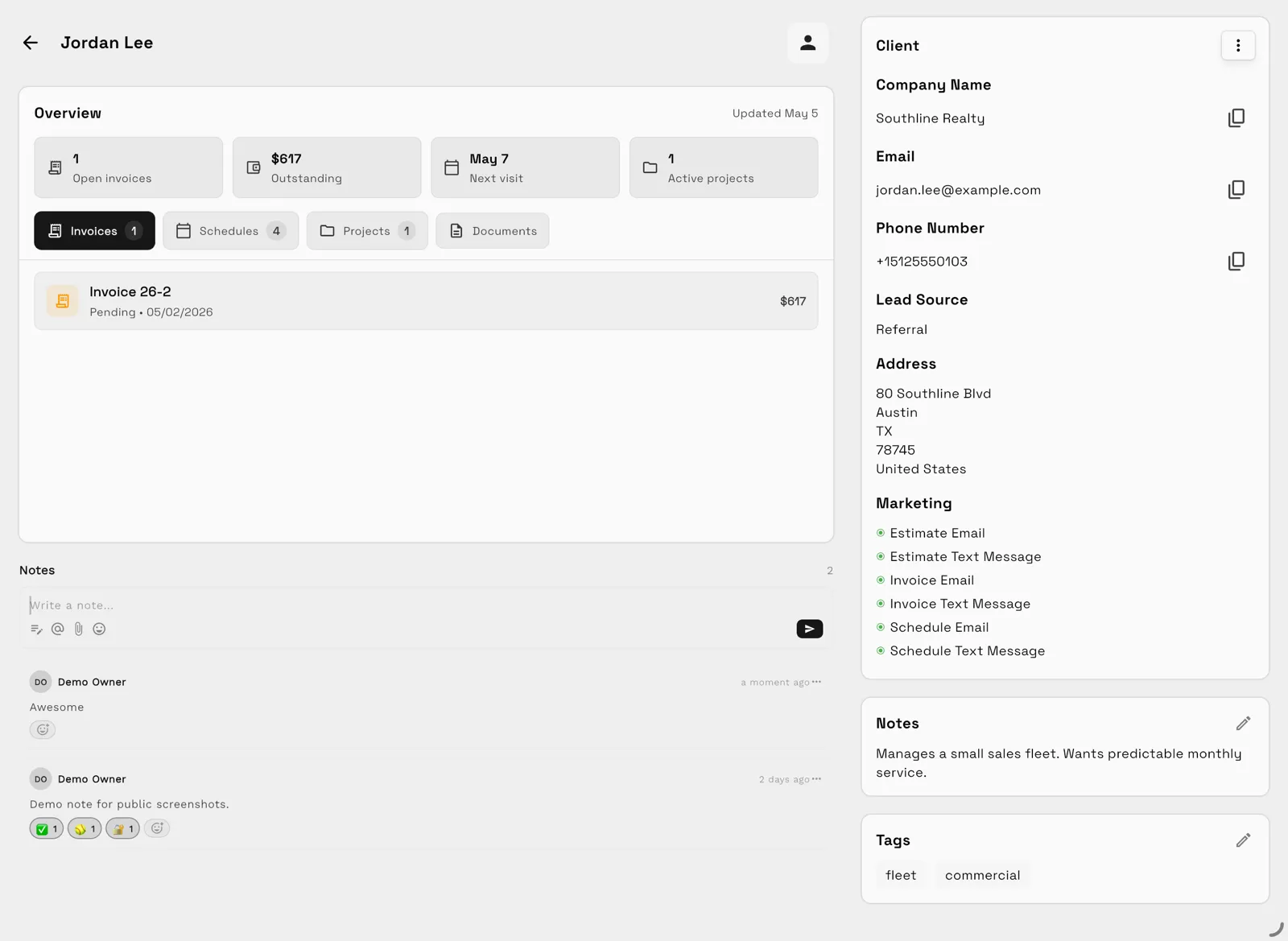
Demo data, not a customer outcome.
Limitations: it has no resource or capacity planning below Commander (the team workload view starts there), and no multi-budget financial editor below Commander (budget vs actual is a Commander feature), and no sprint or code features. It does have per-project hours budgets on the time-tracking feature, on every plan: set an hours budget on a project, watch the hours used and compare them with the budget to see utilization. Productive or Scoro document more for financial budgets and staffing. It is not a sales forecasting pipeline: requests, lead sources and project stages track work, not weighted deals. At 10 users Productive Essential is $120 a month against $149 here, though it lists no signing or portal. The 14-day trial needs a card.
Best for: consultancies of about 4 to 20 people that sell signed scopes, retainers and hourly work and want the client portal, inbox and invoices on one flat plan.
4. Teamwork.com, best for delivery-led teams that bill from logged time
Teamwork.com is project-first. The Free plan covers up to 5 users and 5 projects. Basics is $13.99 per user a month billed monthly ($9.99 billed yearly) with a 3-user minimum, and lists billable time reports and intake request capture. Accelerate is $29.99 per user a month billed monthly ($24.99 billed yearly) with a 5-user minimum, and adds smart request forms with if/then logic, workload and capacity planning, time budgets and retainers, invoices built from logged time and a HubSpot connection. Quotes and "turn CRM pipeline into projects" start at Optimize, which is quote-only. For 10 users that is $139.90 a month on Basics and $299.90 on Accelerate billed monthly, or $99.90 and $249.90 billed yearly. The trial is 14 days with no card required.
Limitations: a pipeline and quotes are not on the plans with public prices.
Best for: delivery-heavy teams that already run a CRM elsewhere and want budgets, capacity and invoices from time.
5. Accelo, best for professional services automation by quote
Accelo positions itself as professional services automation covering pipeline, project delivery, resource capacity and margin. Its pricing page describes pipeline-to-revenue forecasts, utilization planning, budget and progress visibility across projects, and risk signals before margins slip. It shows no prices, plan list or trial: there is only a custom-quote form that asks for your employee range (1-9, 10-19, 20-49 and up), with implementation guidance and onboarding support said to be included in the starting price.
Limitations: nothing on the page lets you compare per-seat cost, seat minimums or plan gates, so we cannot place it higher on documented fit, and we cannot say whether it bills fixed-bid work, retainers and hourly work differently. Ask for a quote with your headcount and your mix of engagement types, and ask which features sit in which tier.
Best for: established consultancies that want a sales-led demo and onboarding support and are comfortable with quote-only pricing.
6. HubSpot CRM, best as a free pipeline beside other tools
HubSpot's free tools are listed as free for up to 2 users with no card required. Starter is $20 per seat a month at list price (the page also shows limited-time new-customer offers, which we do not use for team maths), so 10 seats is $200 at list. The CRM pricing page lists marketing, sales, service, content and data tools and a monthly or annual billing choice, and it does not describe statements of work, time tracking or project budgets. For a consultancy, that makes it a front-of-funnel tool: track discovery calls and follow-ups, then hand the won deal to a delivery tool.
Limitations: no time tracking or project budgets are described on the page, so fixed-bid margin and retainer hours need another tool, and the deal and the hours end up in different systems. Starter seats add up quickly across a delivery team that does not need marketing tools.
Best for: a founder-led consultancy that needs a free pipeline for discovery calls and will track delivery elsewhere.
Side-by-side comparison
| Tool | Entry price (monthly) | Billed yearly | 10-user total | Seat minimum | Pipeline and SOW | Time and invoices | Trial |
|---|---|---|---|---|---|---|---|
| Productive | $12 per user (Essential) | $10 per user | $120 monthly, $100 yearly | 3 seats | Deals, proposal PDF export | Time, invoices; retainers from Professional | 14 days, no card |
| Scoro | $17 per user (Time-billing), period not labelled | 13 to 17 percent annual discount | $170 to $570 at displayed prices | 5 users | CRM app only in End-to-end ($57); Quote to Cash ($29) adds Estimate but no CRM | Time and billing apps | 14 days, no card |
| Workspace369 | $149 (Specialist, 10 seats) | $119.25 a month | Same, 10 seats included | None | Signed Proposals, deposits | Time, retainers, invoices | 14 days, card required |
| Teamwork.com | $13.99 per user (Basics), $29.99 (Accelerate) | $9.99 per user (Basics), $24.99 (Accelerate) | $139.90 / $299.90 monthly, $99.90 / $249.90 yearly | None stated | Quotes and pipeline at Optimize | Time budgets, retainers, invoices from Accelerate | 14 days, no card |
| Accelo | Custom quote | Custom quote | Custom quote | Not stated | Pipeline described | Described, no plan detail | Not stated |
| HubSpot CRM | $0 (free) | $20 per seat list (any billing period) | $200 list | Free: 2 users | Deals tools | Not described | Free, no card |
Which tool fits your consultancy?
| If you mostly need | Start with | Why |
|---|---|---|
| Budgets, hours and project margin for 3 or more people | Productive | Budgets, time, invoices and resourcing in the feature table |
| Quote-to-cash for 5 or more people | Scoro | Estimating, billing and CRM apps you combine |
| Signed scopes, portal and invoices on one plan | Workspace369 | Proposals, retainers and portal on every plan, from Cadet |
| Delivery and capacity first | Teamwork.com | Time budgets and retainers on Accelerate |
| A sales-led PSA with onboarding | Accelo | Custom quote with onboarding included |
| A free pipeline only | HubSpot CRM | Free for up to 2 users |
Test a discovery phase and a fixed bid in the trial
Take one fictional client through both engagement types in each tool you shortlist:
- Add the deal to the pipeline and send a discovery proposal that states, in writing, that it is advisory only.
- Convert the signed discovery into a fixed-bid build with a separate budget.
- Log time against both and edit one entry in the timesheet.
- Raise a scope change in the middle of the build and get written approval.
- Invoice a milestone, then set up the next month's support retainer.
- Export the client record and see what comes out.
Pass if the discovery scope, the build budget, the hours and the invoice agree on one client record. Draft the change request with the free scope-change request builder and attach it to the proposal.

Keep discovery separate from implementation
A recurring risk in this niche is a client reading an advisory discovery as a commitment to build the recommendation. Record the boundary in the proposal, keep discovery tasks and files in their own project, and share only that scope in the client portal. The software consultancies product page shows how Workspace369 handles Proposals, communications and invoices; the pricing page lists current plans and seat counts. Workflow Automations create tasks, send email or SMS, and issue reminders, with email automations on every plan and SMS steps from Voyager.
Before importing real clients, run one full engagement on demo data and check that your records can be exported.
Sources reviewed for this guide
- Workspace369 pricingPlan matrix reviewed October 18, 2026.
- Productive pricingOfficial pricing page reviewed October 18, 2026 for per-user prices in both billing views, the 3-seat minimum, trial terms and the full feature table.
- Scoro pricingOfficial pricing page reviewed October 18, 2026 for combination prices, the 5-user minimum, trial terms and the annual discount.
- Accelo pricingOfficial pricing page reviewed October 18, 2026; it shows a custom-quote form and no prices.
- Teamwork.com pricingOfficial pricing page reviewed October 18, 2026 for yearly-billed prices, plan features and trial terms.
- HubSpot CRM pricingOfficial pricing page reviewed October 18, 2026 for the free CRM limits and Starter list price.
Workspace369 publishes this documentation-based comparison and is one of the options. It is not an independent ranking or a hands-on benchmark.
Run client follow-up in one workspace.
CRM, inbox, voice, invoicing, payments, projects, files, AI, and workflow automations — connected instead of exported.
14-day free trial. Card required. After the trial: from $29/month. Renews automatically every month until you cancel. Cancel anytime in Settings → Billing.