The short version
2026 editionKey takeaways
Each takeaway links to its canonical data row. Reported figures belong to their cited producer; modeled results are labeled as calculations.
- US freelancers who had trouble collecting payment in 2014: 50% (2014 payment year; Freelancers Union survey, July 2015).Freelancers Union
- US freelancers who had trouble getting paid at some point in their career: 71% (Career to July 2015; Freelancers Union survey).Freelancers Union
- Freelancers with payment trouble in 2014 who were paid late: 81% (2014 payment year; Freelancers Union survey, July 2015).Freelancers Union
- Freelancers with payment trouble in 2014 who were not paid at all for some work: 34% (2014 payment year; Freelancers Union survey, July 2015).Freelancers Union
- Average unpaid income reported for 2014: $5,968.00 (2014 payment year; Freelancers Union survey, July 2015).Freelancers Union
- UK freelancers who have experienced a payment delay from a client in their career: 54% (IPSE research, 2022).IPSE (Association of Independent Professionals and the Self-Employed)
- Average amount UK freelancers are currently owed in late payments: £5,230 (IPSE research, 2022).IPSE (Association of Independent Professionals and the Self-Employed)
- Freelancer complaints to DCWP’s Navigation Program: 2,542 (NYC fiscal years 2019–2023; DCWP report, November 2023).NYC Department of Consumer and Worker Protection
- Total payments freelancers reported recovering after complaining: $2,900,000.00 (NYC fiscal years 2019–2023; DCWP report, November 2023).NYC Department of Consumer and Worker Protection
- Unpaid wages reported to the campaign (lower bound): $7,400,000.00 (About May 2024 to May 2025; Freelancers Union, May 2025).Freelancers Union
How often were US freelancers paid late or not at all?
In a 2015 Freelancers Union survey, half of freelancers had trouble getting paid in 2014, and 71% had at some point in their career. Of those with trouble in 2014, 81% were paid late and 34% were not paid at all for some work.
| Measure (Freelancers Union 2015) | Value |
|---|---|
| Had trouble collecting payment in 2014 | 50% |
| Had trouble getting paid at some point in their career | 71% |
| Paid late (of those with trouble in 2014) | 81% |
| Not paid at all for some work (of those with trouble in 2014) | 34% |
| Paid less than the agreed amount in 2014 | 24% |
| Accepted less money to be paid on time (of those with trouble) | 11% |
| Average longest wait to be paid | 98 days |
| Average unpaid income in 2014 | $5,968.00 |
| Average late payments in 2014 | $5,735.00 |
| Share of the average respondent’s annual income lost to nonpayment | 13% |
One survey of one population. The averages are means reported by the producer, not medians, and are in 2014 dollars. Subgroup shares (“of those with trouble”) have a smaller denominator than the whole sample; do not compare them as if they shared one.
Primary source: Freelancers Union — December 10, 2015
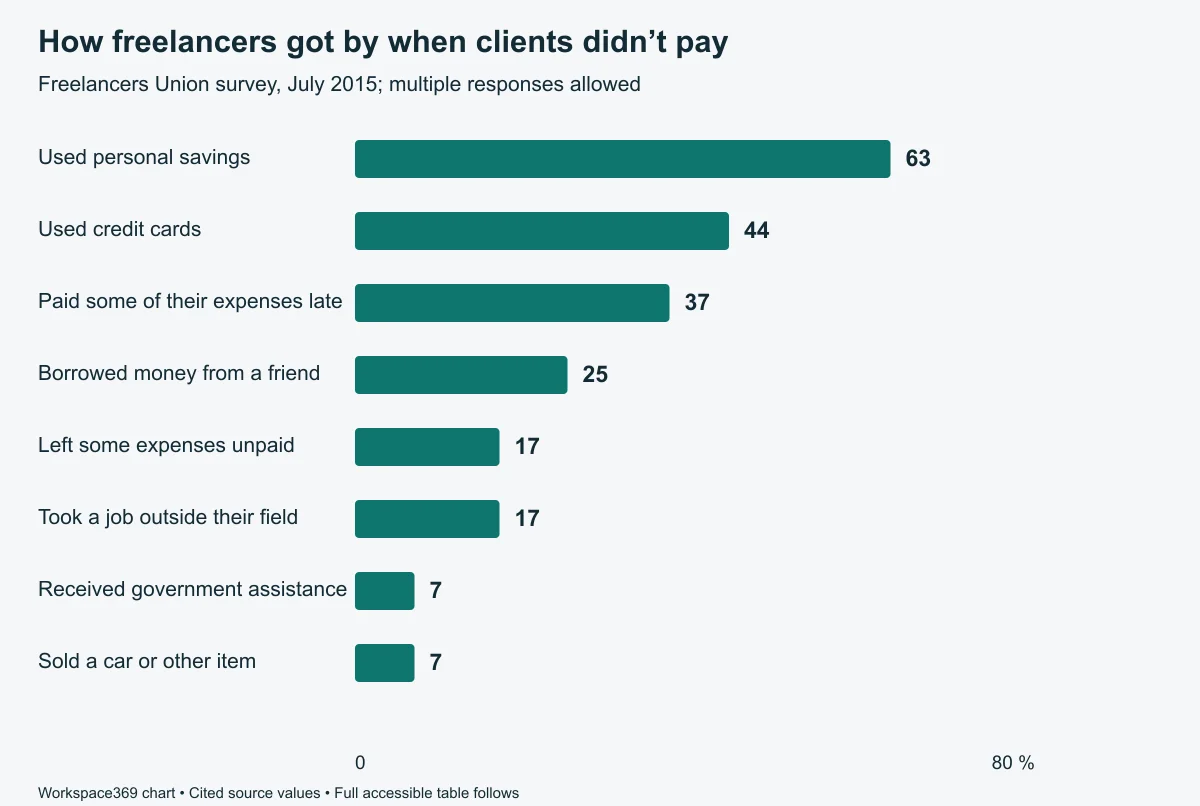
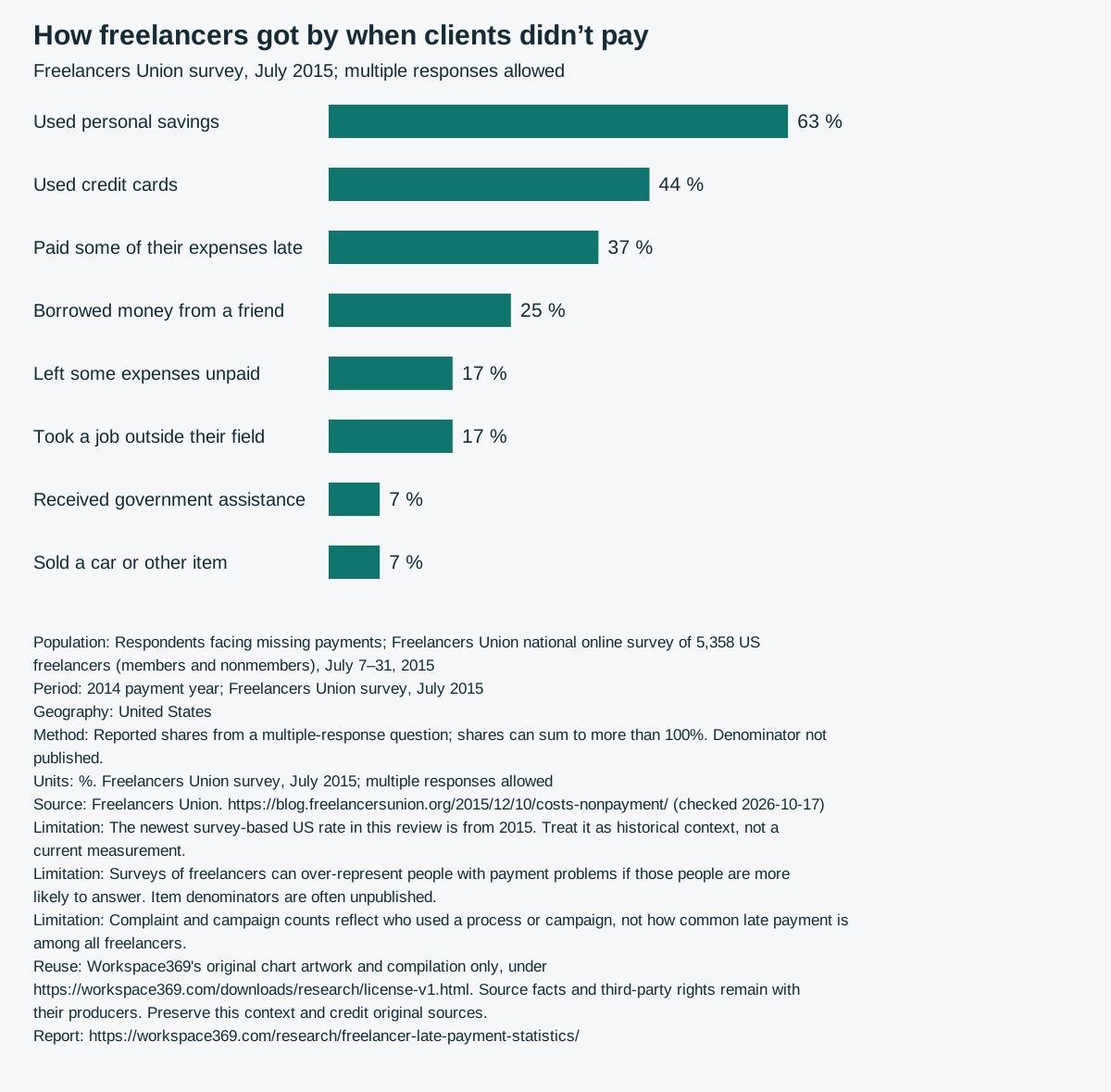
How did freelancers get by when clients didn’t pay?
Most dipped into savings (63%) or used credit cards (44%), according to Freelancers Union’s 2015 survey. More than a third paid some of their own bills late.
| How they got by (Freelancers Union 2015) | Share |
|---|---|
| Used personal savings | 63% |
| Used credit cards | 44% |
| Paid some of their expenses late | 37% |
| Borrowed money from a friend | 25% |
| Left some expenses unpaid | 17% |
| Took a job outside their field | 17% |
| Received government assistance | 7% |
| Sold a car or other item | 7% |
A multiple-response question: one freelancer can appear in several rows, so the rows must not be added.
Primary source: Freelancers Union — December 10, 2015
Did freelancers use contracts, and how did they try to collect?
Only 28% of the freelancers surveyed in 2015 always used a written contract. Facing nonpayment, 92% made repeated phone calls; 5% hired an attorney and 5% went to small claims court.
| Measure (Freelancers Union 2015) | Share |
|---|---|
| Always use a contract | 28% |
| Always put the terms of agreement in an email | 33% |
| Always use a verbal agreement | 42% |
| Have worked with a client who refused to sign a contract | 21% |
| Made repeated phone calls to recover money (facing nonpayment) | 92% |
| Charged late payment fees (facing nonpayment) | 20% |
| Hired an attorney (facing nonpayment) | 5% |
| Went to small claims court (facing nonpayment) | 5% |
The contract questions describe all respondents; the collection rows describe only those facing nonpayment. These categories are not mutually exclusive.
Primary source: Freelancers Union — December 10, 2015
How common is late payment for UK freelancers?
In IPSE’s 2022 research, 54% of UK freelancers had experienced a payment delay from a client during their career, and freelancers were owed £5,230 in late payments on average.
| Measure (IPSE 2022) | Value |
|---|---|
| Not paid on time by a client in the last 12 months | 35% |
| Experienced a payment delay from a client during their career | 54% |
| Waited more than three months past the payment deadline | 18% |
| Completed work and were never paid for it | 31% |
| Average amount currently owed in late payments | £5,230 |
| Used a credit card or overdraft because of late payment | 23% |
| Had no money for basic living costs | 20% |
| Felt stressed or anxious because of late payment | 49% |
UK data in GBP from a different survey and year than the US rows. Do not combine the US and UK percentages or convert the amounts.
Primary source: IPSE (Association of Independent Professionals and the Self-Employed) — checked October 17, 2026
What do New York City’s freelancer complaints show?
Freelancers filed 2,542 complaints with New York City’s Navigation Program in fiscal years 2019–2023, mostly about late or missing payment, and at least 773 reported recovering a total of $2.9 million, according to the city’s five-year report.
| Measure (NYC DCWP, FY2019–2023) | Value |
|---|---|
| Complaints filed | 2,542 |
| Complaints alleging unlawful payment practices (late or non-payment) | 2,184 |
| Complaints alleging failure to provide a written contract | 264 |
| Complaints alleging retaliation | 212 |
| Hiring parties that responded to the complaint notice | 74% |
| Freelancers reporting a recovered payment | 773 |
| Total reported recovered | $2,900,000.00 |
| Complainants who recovered all the money owed | 40% |
| Complainants who recovered part of the money owed | 9% |
| Complaints about contracts of $1,000 or less | 22% |
| Complaints about contracts of $5,000 or less | 51% |
Complaint data shows who used the city’s process, not how common late payment is. The contract-value shares are cumulative ($5,000 or less includes $1,000 or less).
Primary source: NYC Department of Consumer and Worker Protection — November 1, 2023
How much have freelancers reported as unpaid recently?
More than 1,000 freelancers from 44 states reported over $7.4 million in unpaid wages to Freelancers Union’s World’s Longest Invoice in the 12 months to May 2025. These are self-reported campaign entries, not a measured rate.
| Measure (Freelancers Union 2025) | Value |
|---|---|
| Freelancers who added invoices (reported as “over 1,000”) | 1,000 |
| States represented | 44 |
| Unpaid wages reported (reported as “more than $7.4 million”) | $7,400,000.00 |
Lower bounds as published. Participants chose to take part, so the tally cannot be used to estimate how many freelancers are unpaid.
Primary source: Freelancers Union — May 15, 2025
Which laws require freelancers to be paid on time?
New York City, New York State and Illinois require written contracts and set a 30-day default payment deadline for freelancers. UK law lets businesses claim statutory interest on late invoices, and a bill on payment terms and late-payment interest is before Parliament.
Scroll horizontally to compare all columns →
| Jurisdiction and law | In force | Who it covers | Payment deadline | Where complaints go |
|---|---|---|---|---|
| New York City: Freelance Isn’t Free Act | May 15, 2017 | Freelancers hired for $800 or more, in one contract or several with the same client within 120 days. A written contract is required. | The date in the contract, or within 30 days of finishing the work if no date is set. | NYC Department of Consumer and Worker Protection, or court. Double damages can be recovered for late or missing payment. |
| New York State: General Business Law Article 44-A | August 28, 2024 | Freelancers paid $800 or more over 120 days, including several contracts with the same client. Sales representatives, lawyers, licensed medical professionals and construction contractors are excluded. | The date in the contract, or within 30 days of finishing the work if the contract sets no payment date or way of working one out. | New York State Attorney General, according to the state Department of Labor. |
| Illinois: Freelance Worker Protection Act | July 1, 2024, for contracts signed after that date | Independent contractors doing $500 or more of work over 120 days (can be several contracts), where the freelancer works in Illinois or the client is located there. Excludes construction workers, employees, and people contracted by federal, state, local or foreign governments. | The date in the contract, or within 30 days of finishing the work if no date is set. | Illinois Department of Labor, within 2 years of the date final payment was due; the freelancer can also sue. The department does not collect the money. |
| United Kingdom: late payment of commercial debts (current law) | In force (1998 Act) | Payments between businesses for goods or services. Public authorities have their own limit. | An agreed date, usually within 60 days between businesses and 30 days for public authorities; if none is agreed, 30 days after the later of invoice receipt or delivery. Suppliers can claim statutory interest of 8% plus the Bank of England base rate (unless the contract sets another rate), and a fixed recovery cost of £40 to £100. | Small Business Commissioner, for businesses with fewer than 50 employees with payment problems with larger customers (construction cases and disputes between two small businesses fall outside its remit). It makes non-binding recommendations. |
| United Kingdom: Commercial Payments Bill [HL] (proposed) | Not law yet: passed the House of Lords (third reading October 20, 2026) and goes to the House of Commons next (stage as of October 21, 2026) | Commercial contracts. The government’s March 24, 2026 plan covers large firms paying smaller suppliers. | The government’s March 24, 2026 plan (not the bill text) proposes a 60-day cap on payment terms when large firms pay smaller suppliers, and mandatory statutory interest of 8% above base rate in all commercial contracts. | Proposed: new Small Business Commissioner powers to investigate, adjudicate payment disputes and fine persistent late payers. |
Summaries of official guidance, checked on October 19, 2026 (the bill’s stage on October 21, 2026); general information, not legal advice. Thresholds, exclusions and remedies have more detail in each law. The bill may change before it becomes law.
Primary sources: NYC Department of Consumer and Worker Protection — checked October 19, 2026 · NYC Department of Consumer and Worker Protection — November 1, 2023 · New York State Department of Labor — checked October 19, 2026 · New York State Senate (Consolidated Laws) — checked October 19, 2026 · New York State Senate (Consolidated Laws) — checked October 19, 2026 · New York State Senate (Consolidated Laws) — checked October 19, 2026 · Illinois Department of Labor — checked October 19, 2026 · GOV.UK — checked October 19, 2026 · Office of the Small Business Commissioner (GOV.UK) — January 28, 2026 · Department for Business and Trade (GOV.UK) — March 24, 2026 · UK Parliament — checked October 21, 2026
Who publishes late-payment complaint numbers?
Of the jurisdictions here, only New York City’s published five-year report gives freelancer complaint counts we found: 2,542 in fiscal years 2019–2023 (see above). The UK Small Business Commissioner reports small-business cases: 29 formal complaints in 2024–25, and £320,316 paid to small businesses after complaints or OSBC support. We found no published counts for New York State or Illinois.
Scroll horizontally to compare all columns →
| Complaint body and period | Enquiries handled | Formal complaints | Payments to small businesses |
|---|---|---|---|
| NYC DCWP, fiscal years 2019–2023 (freelancers) | Not published as enquiries | See the New York City section above | See the New York City section above |
| UK Small Business Commissioner, 2024–25 | 591 | 29 | £320,316.07 |
| UK Small Business Commissioner, 2023–24 | 618 | 22 | £390,900 |
| New York State Attorney General | Not published | Not published | Not published |
| Illinois Department of Labor | Not published | Not published | Not published |
The NYC figures are freelancer complaints; the UK figures cover businesses with fewer than 50 employees and are not specific to freelancers. Do not add or compare them as one rate. “Not published” means we found no figure on the agency’s own site on October 19, 2026.
Primary sources: NYC Department of Consumer and Worker Protection — November 1, 2023 · Office of the Small Business Commissioner (GOV.UK) — January 28, 2026
How should these figures be used together?
Use each figure with its source, year and population. The surveys measure how often freelancers report trouble; the NYC data counts complaints; the campaign tallies self-reported invoices. None of them is a current, pooled late-payment rate.
The Freelancers Union survey is from 2015 and describes 2014. IPSE’s figures are UK data from 2022. Newer primary surveys of freelancer late payment are scarce; check the producer’s site before quoting any figure as current.
Is this a Workspace369 survey?
No. Workspace369 compiled these findings from the cited producers. No respondents were recruited and no figures were modeled for this page.
Corrections are welcome with the statistic ID and primary-source evidence.
How this report was built
Methodology and limitations
- Figures were transcribed from each producer’s own publication and checked against it on October 17, 2026. Every ledger row keeps the producer, year, population and an exact locator.
- Freelancers Union’s 2015 report is linked from its December 10, 2015 announcement. The report links there now return HTTP 403, so page locators refer to the same file (FU_NonpaymentReport_r3.pdf) as preserved by OnLabor: https://onlabor.org/wp-content/uploads/2017/05/FU_NonpaymentReport_r3.pdf.
- IPSE’s report page does not show a publication date, sample size or fieldwork period. IPSE’s prompt-payment campaign page describes it as its research from 2022, which is the year used here.
- No averages were computed across sources, no currencies were converted and no figures were inflation-adjusted.
- The law and complaints rows were added on October 19, 2026 from official sources only: NYC DCWP, the New York State Department of Labor and Consolidated Laws, the Illinois Department of Labor, GOV.UK, UK Parliament and the Office of the Small Business Commissioner’s 2024–25 annual report. The bill’s stage was read from UK Parliament’s bill record that day and rechecked there on October 21, 2026, after the Lords third reading.
What these numbers cannot tell you
- The newest survey-based US rate in this review is from 2015. Treat it as historical context, not a current measurement.
- Surveys of freelancers can over-represent people with payment problems if those people are more likely to answer. Item denominators are often unpublished.
- Complaint and campaign counts reflect who used a process or campaign, not how common late payment is among all freelancers.
Freshness and corrections
Maintained by the Workspace369 editorial team. Editorial owner reviews sources quarterly and when a producer publishes a new edition. Next review January 2027. The edition date changes only when the evidence or content is substantively reviewed; it does not change the underlying observation period.
First edition: . Data extraction, source attribution and arithmetic checked for this edition. No independent peer review is claimed.
Found an error or a newer primary release? Send a correction with the source and affected statistic. Confirmed corrections are recorded below before republishing.
Revision history
Evidence dates above describe the report. Download and citation updates below do not imply that sources were checked again.
- — First publication: Freelancers Union 2015 survey, IPSE 2022, NYC DCWP FY2019–2023 complaint data and the Freelancers Union 2025 campaign tally, each shown separately.
- — Added a law tracker (New York City, New York State, Illinois, current UK law and the Commercial Payments Bill) and a complaints section with the UK Small Business Commissioner’s 2024–25 and 2023–24 casework figures, from official sources only. Existing survey and NYC figures are unchanged.
- — Updated the Commercial Payments Bill row: the House of Lords held third reading on October 20, 2026 and the bill goes to the House of Commons next, per UK Parliament’s bill record. No other figures changed.
Primary sources and provenance
Every reported numeric cell links directly to its producer. The downloads include exact table or workbook locators, observation periods, access dates, formulas and input references.
- Freelancers UnionThe Costs of Nonpayment: A Study of Nonpayment and Late Payment in the Freelance Workforce ↗Published December 10, 2015. Accessed October 17, 2026.Selected factual observations with attribution. The source report and underlying responses remain with Freelancers Union; this compilation does not relicense them.
- IPSE (Association of Independent Professionals and the Self-Employed)Late payment within the self-employed sector ↗Publication date not recorded; see the original source. Accessed October 17, 2026.Selected factual observations with attribution. The source report and underlying responses remain with IPSE; this compilation does not relicense them.
- NYC Department of Consumer and Worker Protection5-Year Report on NYC’s Freelance Isn’t Free Act ↗Published November 1, 2023. Accessed October 17, 2026.New York City government publication; attribution requested. No agency endorsement.
- Freelancers UnionOne year of the World’s Longest Invoice ↗Published May 15, 2025. Accessed October 17, 2026.Selected factual observations with attribution. The source report and underlying responses remain with Freelancers Union; this compilation does not relicense them.
- NYC Department of Consumer and Worker ProtectionFreelance Workers ↗Publication date not recorded; see the original source. Accessed October 19, 2026.New York City government publication; attribution requested. No agency endorsement.
- New York State Department of LaborFreelance Isn’t Free Act ↗Publication date not recorded; see the original source. Accessed October 19, 2026.New York State government publication; attribution requested. No agency endorsement.
- New York State Senate (Consolidated Laws)General Business Law §1410: Definitions ↗Publication date not recorded; see the original source. Accessed October 19, 2026.New York State government publication; attribution requested. No agency endorsement.
- New York State Senate (Consolidated Laws)General Business Law §1411: Contracted compensation payments ↗Publication date not recorded; see the original source. Accessed October 19, 2026.New York State government publication; attribution requested. No agency endorsement.
- New York State Senate (Consolidated Laws)General Business Law §1412: Written contracts ↗Publication date not recorded; see the original source. Accessed October 19, 2026.New York State government publication; attribution requested. No agency endorsement.
- Illinois Department of LaborFreelance Worker Protection Act FAQs ↗Publication date not recorded; see the original source. Accessed October 19, 2026.State of Illinois government publication; attribution requested. No agency endorsement.
- GOV.UKLate commercial payments: charging interest and debt recovery ↗Publication date not recorded; see the original source. Accessed October 19, 2026.Contains public sector information licensed under the Open Government Licence v3.0.
- Department for Business and Trade (GOV.UK)Time to Pay Up: Government unveils toughest crackdown on late payments in over 25 years ↗Published March 24, 2026. Accessed October 19, 2026.Contains public sector information licensed under the Open Government Licence v3.0.
- UK ParliamentCommercial Payments Bill [HL] ↗Publication date not recorded; see the original source. Accessed October 21, 2026.Contains Parliamentary information licensed under the Open Parliament Licence v3.0.
- Office of the Small Business Commissioner (GOV.UK)Office of the Small Business Commissioner annual report and accounts 2024 to 2025 ↗Published January 28, 2026. Accessed October 19, 2026.Contains public sector information licensed under the Open Government Licence v3.0.
Made to be checked, then cited
How to cite this report
For a source-reported statistic, credit the original publisher and link to the exact row here when using our compilation. For a modeled result, cite Workspace369 and include the assumptions. Linking to this page does not make us the original producer of third-party data.
Workspace369. (2026-10-21). Freelancer Late Payment Statistics: What the Primary Sources Show. https://workspace369.com/research/freelancer-late-payment-statistics/. Primary sources and observation periods as listed in the report.
Download reusable chart with sources and limitations ↓
Versioned data
Use an archived file when your analysis needs to stay reproducible. The version identifies the exact CSV and JSON bytes; unchanged data keeps the same version.
Dataset version: 904712fe63bcdc2cf31ef3de16cf1ce9f7cf3ff8c827df0b153c06306896e33f
Reference exports describe Workspace369’s compilation. When citing a reported observation, also credit its original producer.