Best project management and invoicing software in 2026
Five project management and invoicing tools compared for client work: ClickUp, Asana, Bonsai, QuickBooks and Workspace369, with where each falls short.

By Simon Dziak, Founder, Workspace369 · LinkedIn
Choosing project management and invoicing software comes down to one question: which side of the work do you need the tool to be strongest at? The project explains what was promised and delivered. The invoice explains what should be paid. This guide compares five options on how well they keep the two together.
What's inside?
Quick answerWhat to look forWhy projects and invoices need each otherBest options comparedWhere Workspace369 is the strongest fitWorkspace369 versus a separated stackHow Workspace369 connects the project board to the paid invoiceFinal recommendation
Quick answer
- Projects and billing on one client record: Workspace369, which ranks first here because time tracking, proposals and invoices sit beside every project. Its invoicing and project management software page lists what each plan includes.
- The deepest project views: ClickUp or Asana, with billing kept in a separate tool.
- Service-firm admin around proposals, contracts and time: Bonsai.
- Bookkeeping first: QuickBooks, with project delivery tracked elsewhere.
If expenses and accounting matter as much as the project board, check plan limits before you choose: in Workspace369, expenses start on Specialist and full accounting on Commander.
What to look for
The right platform should support:
- Projects, tasks, subtasks, calendar, notes, files, and templates
- Proposals, invoices, recurring invoices, retainers, and change orders
- Payment links, payment plans, deposits, and payment status
- Expenses, accounting signals, inventory, AR aging, and profitability
- CRM, inbox history, SMS, voice, voicemail, reminders, and AI follow-up
- Reporting that connects work status with financial status
Project tools can keep a team moving. Invoicing tools can collect money. The strongest operating system connects both.
Why projects and invoices need each other
Most service work changes after the first conversation. Scope shifts, tasks get added, appointments move, and clients ask follow-up questions.
When invoices are disconnected from projects, the same problems keep showing up:
- The invoice does not reflect the latest scope.
- Change orders and retainers are hard to track.
- Payment status is hidden from the delivery team.
- Project profitability requires manual exports.
- Client questions require searching multiple apps.
The stronger workflow keeps delivery and billing connected to the same client record.

Best options compared
Workspace369 is our product, so weigh this comparison accordingly — the criteria above are exactly what we evaluated.
| Rank | Software | Best for | Where it can fall short |
|---|---|---|---|
| 1 | Workspace369 | Client-work teams that need project management, invoicing, payments, inbox, files, AI, accounting, inventory, and reporting | More than needed for a team that only needs tasks |
| 2 | ClickUp | Flexible work management, dashboards, docs, time tracking, and automations | Billing, payments, phone/SMS, accounting, and client portals usually need more setup |
| 3 | Asana | Structured project execution, portfolios, workload, goals, and approvals | Invoicing, payments, CRM, voice/SMS, and finance are not native operating layers |
| 4 | Bonsai | Service firms that need projects, proposals, contracts, time tracking, and billing | Broader inbox, voice/SMS, accounting, inventory, and operational reporting may be limited |
| 5 | QuickBooks | Accounting, invoices, expenses, payments, and bookkeeping | Project delivery, CRM, inbox, files, AI, and client-work operations usually live elsewhere |
Where Workspace369 is the strongest fit
Workspace369 connects the work and the money.
A project can hold tasks, files, notes, client context, inbox history, proposals, invoices, payment status, expenses, and reports. That gives owners a clearer view of what is happening before the end of the month.
The practical result is less reconciliation. The team does not need to ask whether the task board, invoice app, file folder, and CRM are telling the same story.
Workspace369 versus a separated stack
A dedicated project tool plus a dedicated invoice app can work. The cost shows up in the handoffs between them.
| Workflow | Separate tools | Workspace369 |
|---|---|---|
| Scope changes | Manually copied from the project app to the invoice app | Work and billing stay near the client record |
| Client questions | Search the inbox, project board, and billing app | Client context stays together |
| Payment follow-up | Manual reminders and spreadsheets | Payment status and follow-up live in the workspace |
| Reporting | Exports and reconciliation | Revenue, expenses, AR, and client activity connect |
| Team handoff | Status lives in people's heads | Notes, tasks, files, and history stay visible |

How Workspace369 connects the project board to the paid invoice
It helps to see the connected workflow as screens instead of a checklist. The board below is where delivery lives. Client work moves through stages from Planning to Completed, and every card carries its owner, progress, priority, and budget, so the state of the whole book of work is readable at a glance.
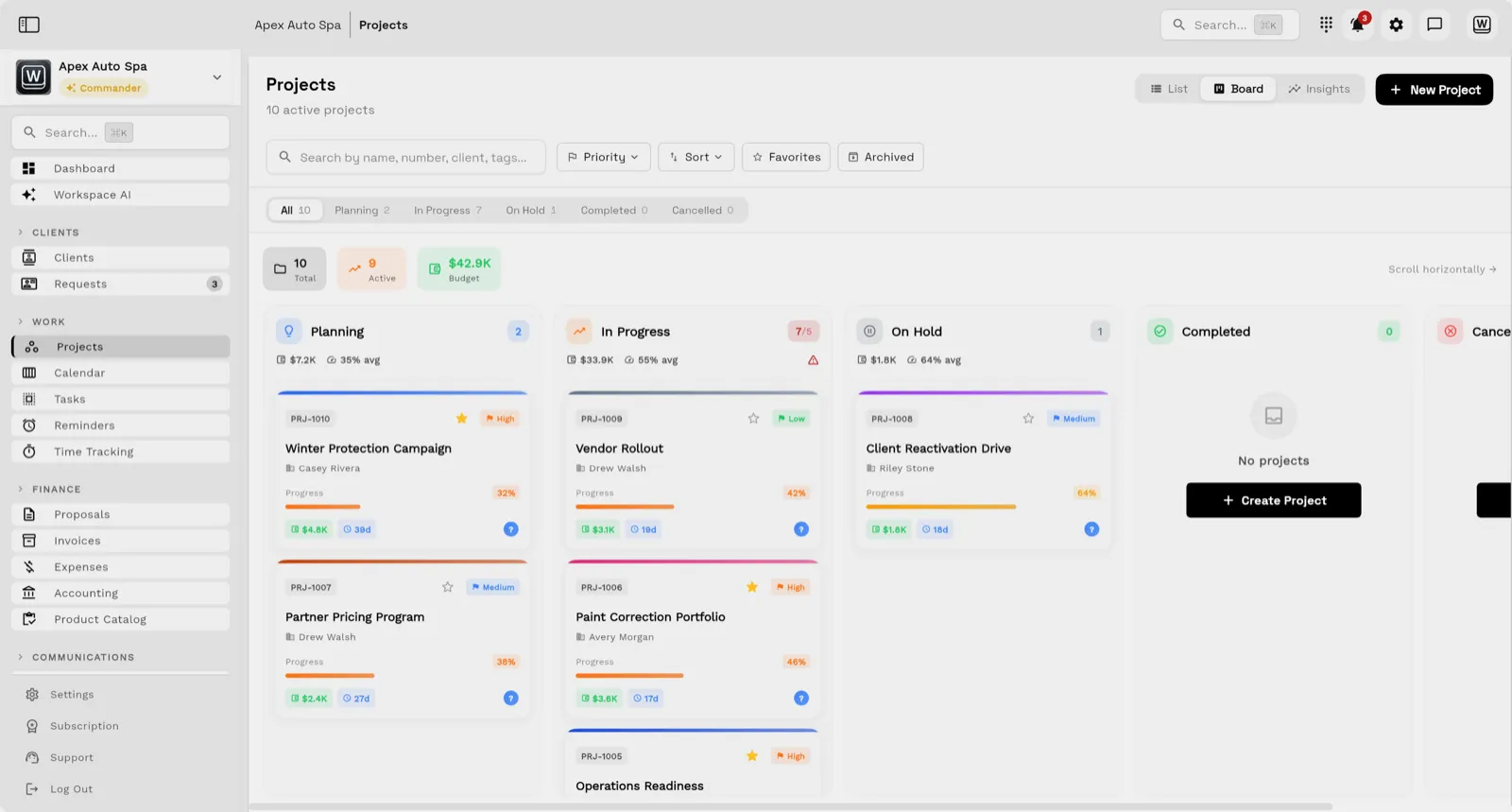
The sidebar beside Projects is the point: Proposals, Invoices, Expenses, and Accounting sit one click away. When a client accepts a proposal built from the agreed scope, the project on this board and the invoice that follows stay attached to the same client record instead of being copied between apps.
When the work is ready to bill, the team opens the invoice editor below. The invoice carries the line items, units, rates, and tax for the job. Tabs across the top cover the payment plan, PO matching, and audit history, and the live preview shows payment status — in this screenshot, "Partially paid," with the paid-to-date amount and the remaining balance next to a Pay Now button. The billing side is covered in more depth in how invoices and payment plans work inside the workspace.
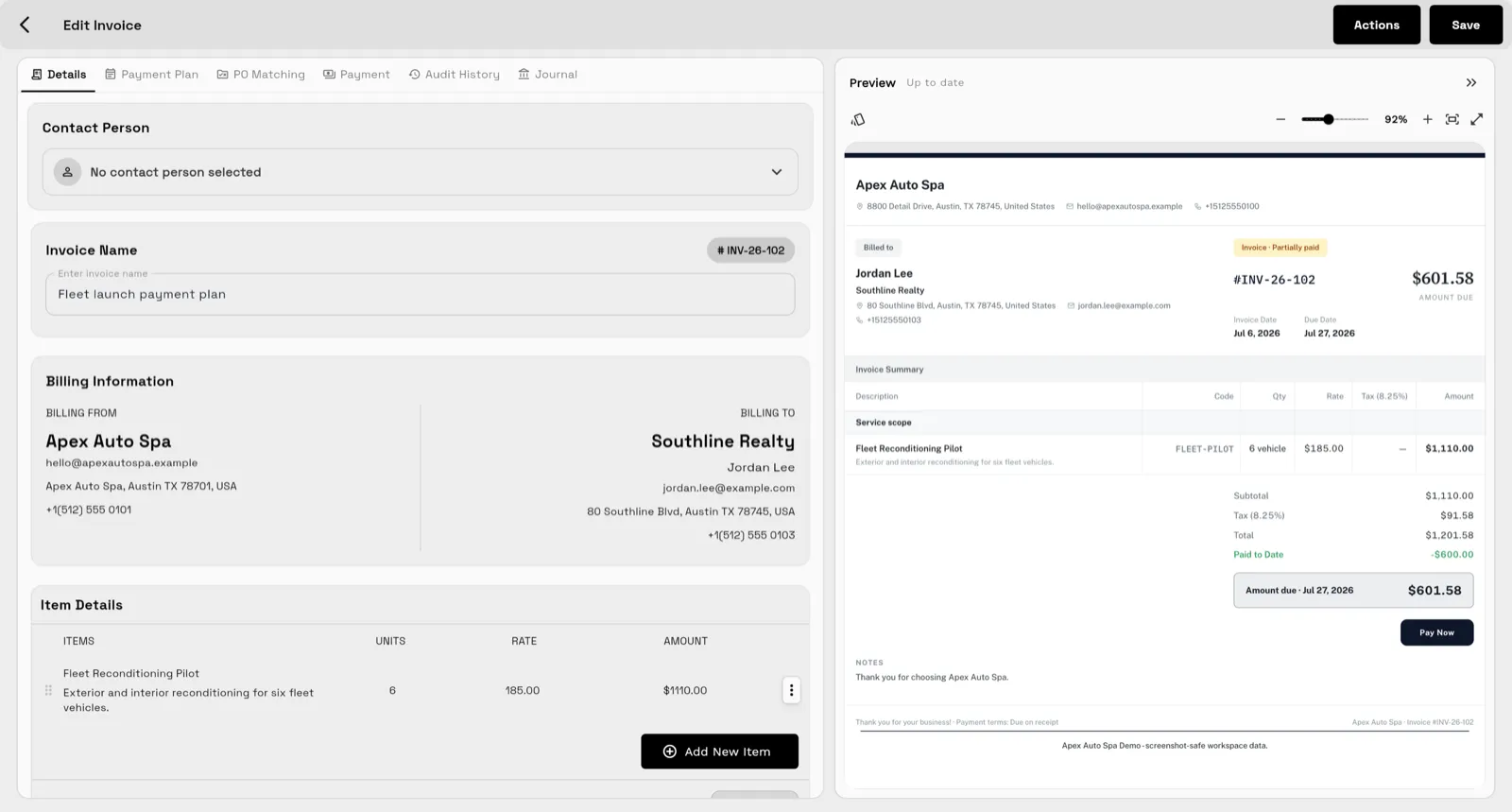
Because the board and the invoice point at the same client record, month-end stops being a reconciliation exercise. Reporting that joins work status with financial status shows what was delivered, what was billed, and what is still outstanding — no exports, no spreadsheets.
Final recommendation
Choose a project and invoicing system that matches the whole client lifecycle.
If your team only needs task execution, choose a dedicated project tool. If you only need bookkeeping, choose an accounting tool. If you need projects, invoices, payments, communication, files, AI, and reporting together, choose Workspace369.
Run client follow-up in one workspace.
CRM, inbox, voice, invoicing, payments, projects, files, AI, and workflow automations — connected instead of exported.
14-day free trial. Card required. After the trial: from $29/month. Renews automatically every month until you cancel. Cancel anytime in Settings → Billing.